
New Britain Parole and Probation
Parole is a conditional release from a Connecticut DOC sentence. The Connecticut Board of Pardons and Paroles decides whether parole is granted and sets conditions. DOC Parole and Community Services supervises and enforces many of those conditions in the community. Probation is ordered by a court, often as a sentence or as part of a sentence, and is supervised through the Connecticut Judicial Branch adult probation system.
A New Britain case can involve both systems at different stages. Someone may serve a DOC term, move to parole or special parole, and also have a probation obligation in the judgment. The court docket, DOC status, board record, and responsible office should be reconciled before describing the person's status.
| Feature | Parole or special parole | Probation |
|---|---|---|
| Authority | Connecticut BOPP and DOC | Connecticut court and adult probation |
| How it starts | Board release or sentence provision | Court order or judgment |
| Local route | Hartford Parole and Community Services | New Britain-area adult probation office |
| Best public record | DOC status, BOPP hearing or decision record | Court disposition and probation office |
| How it ends | Discharge, maximum term, or authorized board/DOC action | Completion or a later court order |
- Parole
- Conditional community release before the controlling sentence is fully discharged.
- Special parole
- A post-incarceration supervision term imposed as part of a sentence.
- Probation
- Court-ordered community supervision administered through the Judicial Branch.
- Absconder
- A supervised person who fails to maintain required contact with the parole system.
Verify New Britain Release Supervision
Start with the judgment and custody source. BOPP is not a general list of every person released in New Britain, and an adult probation office is not a parole locator. The agency must match the supervision type.
- Search the Connecticut court case by defendant name or docket number. Read the disposition and sentence for probation, incarceration, or special parole terms.
- Check the Connecticut DOC inmate search if the person served or remains under a DOC sentence. Compare the reported status and facility or supervision location.
- Use the Connecticut Board of Pardons and Paroles hearing links and resources when parole eligibility, a board vote, or a hearing is involved.
- Contact Hartford Parole and Community Services for regional parole-supervision routing. Do not ask it to confirm an unrelated probation case.
- For probation, confirm the court order and contact the correct Judicial Branch adult probation office.
- When a public result is unclear, request the official record from the court, DOC Public Information, or BOPP FOI as appropriate.
The New Britain release-record hub covers police-only releases and people who never entered DOC custody. Those cases may lead to probation without ever producing a state inmate result.
Hartford Supervises New Britain Parole
The regional field office is in Hartford, not New Britain. That distinction matters because the criminal case can remain tied to New Britain Superior Court while parole supervision is administered through a state DOC office in another city. The statewide DOC Parole and Community Services overview explains the larger division in which the regional office operates.
Hartford Parole and Community Services300 Sheldon Street
Hartford, CT 06106
Phone: 860-297-4400
Fax: 860-297-6599
The official Hartford parole office page provides the current directions and contact context. Its page is shown below so the state source can be recognized.
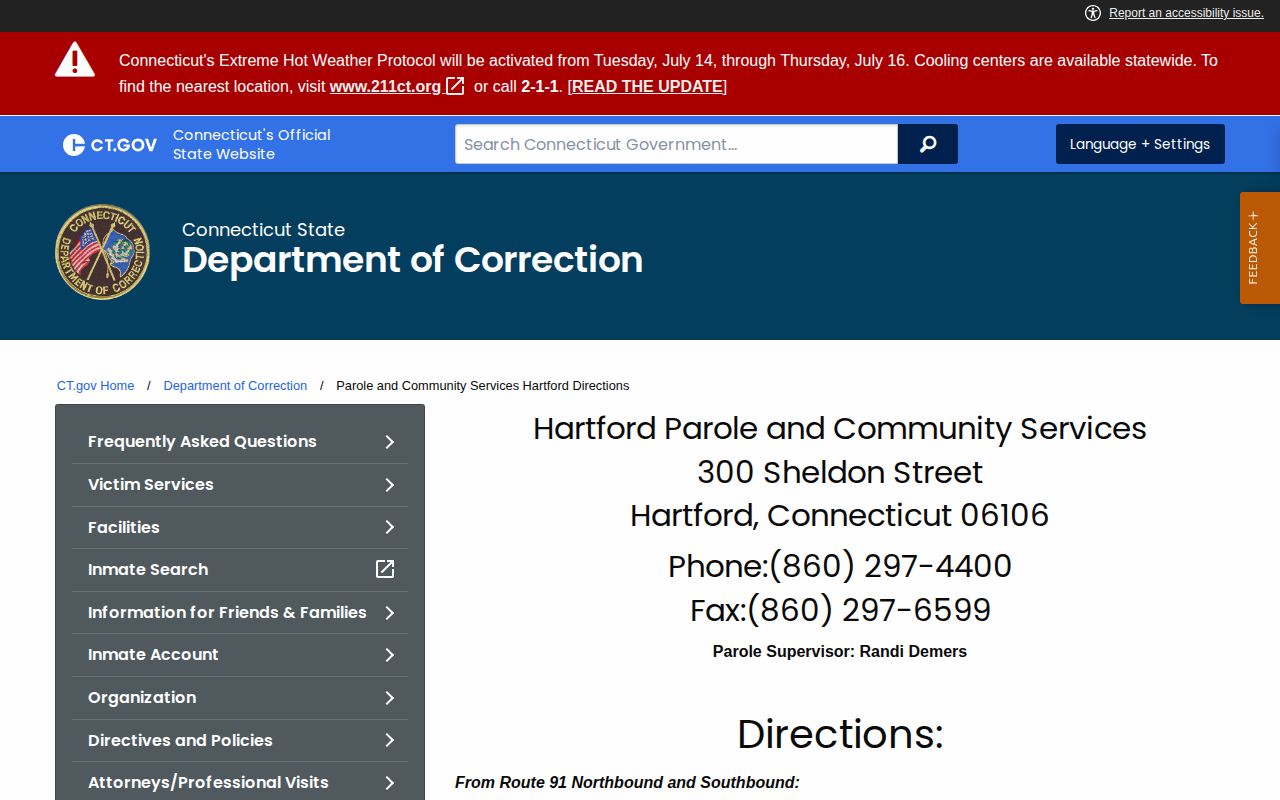
This office is a contact and supervision route, not a public roster. Use DOC, BOPP, and court records first to establish which supervision type applies.
New Britain Probation Office Route
Probation is court-managed. The researched 211 Connecticut adult probation listing points to 225 North Main Street in Bristol, phone 860-584-0073, with weekday hours from 9:00 a.m. to 5:00 p.m. A Judicial Branch directory mirror provides similar secondary context, so the court case and current official directory should still be checked before a visit.
A court docket can show that probation began after time served, a suspended sentence, or another disposition. It may also show later violation-of-probation events. The presence of probation does not prove that parole applies, and the absence of a BOPP record does not cancel a court probation term.
Note: Verify current office assignment with the Connecticut Judicial Branch because supervision locations and case routing can change.
New Britain Parole Hearing Records
BOPP's homepage functions as a current hearing gateway. It posts live public hearing links by date, states that hearings begin at 9:00 a.m. unless otherwise posted, and links to the State Agency Public Meeting Calendar. The calendar can be filtered for board events. Hearing links change, so a date-specific page should be checked close to the event.
The board's FAQ says current practice is to hold hearings about six months before eligibility for eligible people. Outcomes can include a grant with an on-or-after date, denial without further consideration, denial with a later hearing date, continuance, modification, offset, or rescission. The board also publishes its parole regulations resources. No separate public decision-search database was verified in the research. BOPP contact or FOI and the person's DOC record are the fallback for a final outcome.
Board livestreams also have rules. BOPP states that unauthorized recording of a livestreamed proceeding is prohibited under its posted rule and Connecticut law. Use the official hearing access and FOI path for copies.
New Britain Parole Date Limits
A board vote does not prove that release occurred. BOPP describes a voted-to-parole date as an on-or-after date. Parole staff may still review a sponsor, arrange placement and transport, and set conditions. New information, discipline, new charges, or program events can cause modification, delay, offset, or rescission before release.
After the voted date, compare DOC status and VINE with the board record. If DOC still reports secure custody, the voted date should not be restated as the actual release date. The New Britain Release Date Lookup explains RREC, 85 percent designations, and other date changes.
New Britain Absconder Status
BOPP defines absconding as a parolee's failure to maintain contact with the parole system. It is a supervision status, not a synonym for any missed appointment and not proof that an online warrant database exists. Confirm the status with DOC or the supervising agency.
Connecticut DOC publishes a fugitive investigation tip line for parole absconders, transitional-supervision escapees, and other identified cases. The line is 860-982-2372, and the published email is CT.FUGITIVE@ct.gov. Those channels are for providing information to DOC, not for obtaining a general release list or deciding on one's own that a person is wanted.
A violation can lead to investigation, a warrant or retake process, a hearing, modified conditions, revocation, or return to custody. The actual result depends on the order and agency record.
New Britain Reentry Before Release
Connecticut DOC states that each facility has a full-time reentry counselor and that intensive planning starts before release. The official program describes coordination involving identification, medical and behavioral-health needs, medication, recovery support, and community appointments. This applies to New Britain cases that moved into DOC custody through Hartford Correctional Center, York, or another state facility.
Reentry planning is not a public supervision lookup. It helps explain why a projected parole date may require preparation and why a released person can have appointments or conditions immediately after leaving secure custody. The actual supervision term still comes from the judgment, DOC status, and board or court record.
IDs After New Britain Discharge
DOC's property rule provides a practical post-release path. Identification brought into DOC custody is separated from other property and held at the facility until discharge. If left behind, the discharging site keeps it for 30 days. It is then sent to DOC Central Office and can be held there for up to two years.
A released person or family member can ask about an ID at Central Office by calling 860-692-6836 or 860-692-7869, or emailing DOC.ORSU@ct.gov. This does not cover property held by New Britain Police, a court, BOP, or ICE, each of which has its own record and return process.
End New Britain Supervision
Physical release and final discharge are separate milestones. Parole or special parole can continue until the controlling term ends or an authorized action changes it. Probation ends according to the court order or a later court action. A person should not be described as free of supervision based only on an old facility release date.
For formal proof, obtain the discharge, court, DOC, or BOPP record from the responsible custodian. Connecticut erasure law can later restrict public display after all statutory conditions are met. An absent old result may reflect lawful erasure rather than an incomplete search.
Match the request to the record creator. A probation completion question belongs with the court and Judicial Branch supervision record. A parole discharge question belongs with DOC or the board record that controls the term. If the person had both forms of supervision, completion of one does not establish completion of the other. Ask for the status and end date of each separate term.
Older public results can also use words that need context. “Released” may refer only to departure from secure custody. “Discharged” may refer to the end of a particular DOC status. A closed court case does not always prove that a different supervision case ended. Reading the docket number, DOC number, agency, and date together prevents one record from being applied to another person or term.