
New Britain Three-Day Feed Status
New Britain does not publish an official 72-hour released-inmate list in the researched public sources. The city has a police department, not a county sheriff or county jail. Connecticut routes people who remain held into court and state correctional systems. That structure means there is no local page to sort by a rolling three-day release date.
The New Britain Police weekly blotter is the closest local public list, but it logs police activity on a weekly cadence. It does not state who was released, when release occurred, or whether a person transferred to DOC. A court order, state custody status, or police record must supply those facts.
Check New Britain 72-Hour Records
After three days, the record trail may be clearer than it was on the day of arrest. A court appearance may have set bond or imposed conditions. DOC may have received a person held after New Britain Superior Court. VINE may have processed a custody change. Police records may also have passed initial review, though the Records Bureau states that reports are generally available in three to five working days.
- Start with the New Britain Police blotter for an arrest-event clue, not a custody conclusion.
- Use the Connecticut Judicial Branch criminal case lookup to review bond, court dates, dispositions, sentences, probation, and commitments.
- Search CT DOC Inmate Information when the person may have entered Hartford Correctional Center, York Correctional Institution, or another state facility.
- Open Connecticut VINE to check a specific person's recent custody status or to register for a later change.
- Contact New Britain Police Records or file through the City FOIA portal for a release that occurred before DOC admission.
- Use DOC Public Information when state data is missing, excluded, or inconsistent with the court case.
Hartford Correctional Center officially serves New Britain Superior Court for adult male pretrial custody. York serves all Connecticut superior courts for women. Because both are state facilities outside New Britain, a person may have a statewide DOC result even though no local jail page exists. A DOC facility change also can happen during the three-day window.
Note: Match common names with a docket number, birth date, or DOC number before relying on a result.
New Britain 72-Hour Record Fields
An official New Britain three-day feed has no field set because the feed does not exist. The useful fields are distributed across police, court, DOC, and VINE records. Read each item in the context of its source.
| Field | Source and meaning |
|---|---|
| Police event date | Blotter or report context for the arrest, not release proof. |
| Defendant and docket | Court identity and case history for the New Britain matter. |
| Bond and disposition | Court action that may explain release or continued detention. |
| DOC number and facility | State correctional identity and current placement when received by DOC. |
| Custody or supervision status | Whether DOC or VINE reports custody, release, or a related status. |
| Release, discharge, or status date | A recorded change that may still require current confirmation. |
| Sentence or probation terms | Court information about what follows physical release. |
CT DOC says public data is updated daily, yet it also warns that status can change quickly and not all changes are processed at once. VINE depends on participating-agency feeds. Court data may explain why custody changed but can be limited by erasure, sealing, or other public-access rules. The three systems answer related, not identical, questions.
New Britain Weekend Release Checks
A 72-hour window often spans a weekend or holiday. That matters in New Britain because the Records Bureau operates Monday through Friday and closes on official government holidays. A police report that would usually be reviewed within three to five working days may not be ready during a calendar three-day span. The public court and DOC tools can still be checked, but a recent event may not yet have a final record.
For a pretrial person, bond and court orders can change custody faster than office records are released. A person may leave police processing, appear in court, enter Hartford CC or York, and later transfer. Each change has its own time stamp and custodian. Do not force those events into a single assumed release time.
The Connecticut Division of Criminal Justice records guidance explains that its office does not provide public criminal-history information and routes users to the proper state sources. The project capture below reinforces that agency-routing point.
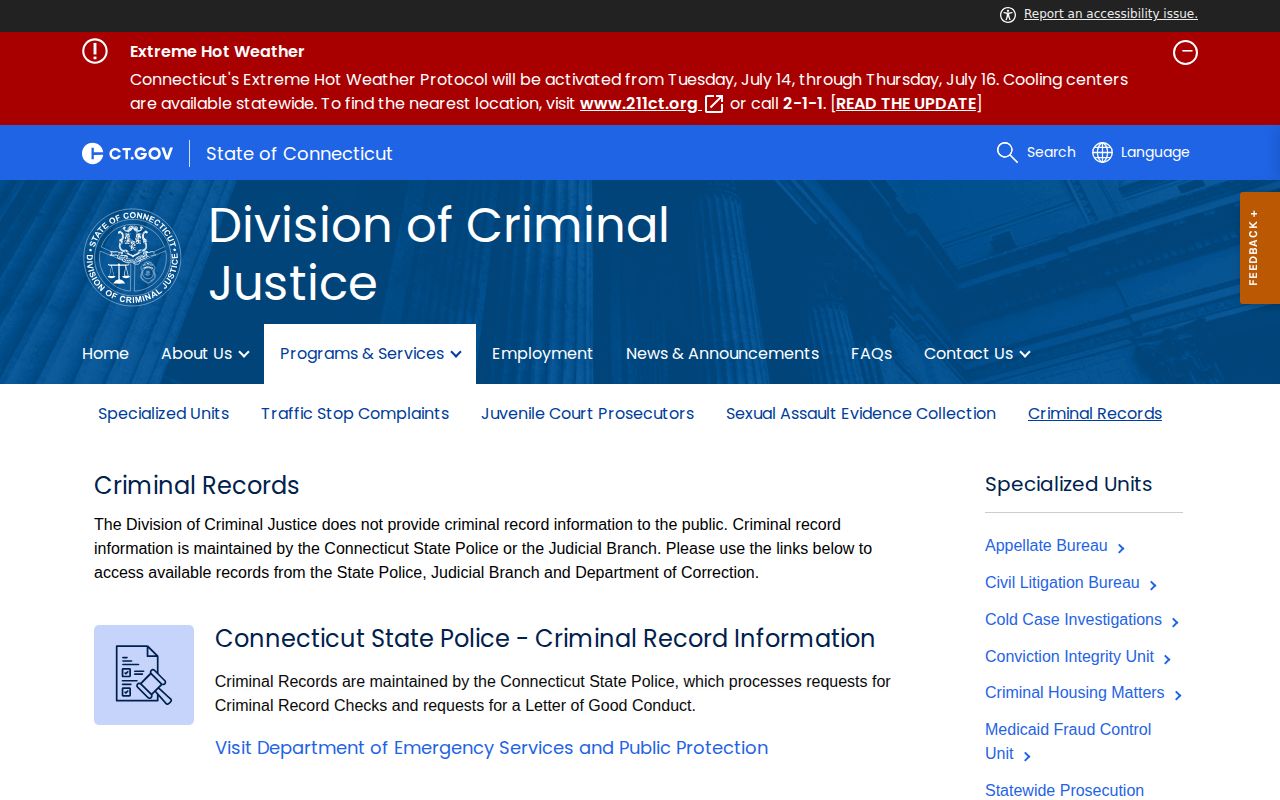
The correct route is the Judicial Branch for case events, DOC for state custody, and the police or city for local records. Waiting for the right custodian is more reliable than treating a weekly blotter as a release log.
New Britain Release Data Quirk
The absence of a local release board shapes every New Britain three-day check. Many county sites let a user filter a sheriff roster by release time. New Britain cannot be searched that way. Its city police page begins the trail, while the court and state correctional systems explain where the person went.
After 72 hours, a person who stayed in custody should often have a stronger court or DOC trail. If DOC shows no match, the person might have been released at the police or court stage, might never have entered DOC, or might fall within an exclusion. DOC states that Youthful Offender and immigration-held information is excluded from its public database. An absent state result is therefore a clue, not a release certificate.
- Release
- Leaving the custody named in a record.
- Transfer
- Movement to another facility or authority without community release.
- Remand
- A court order sending or returning a person to custody.
- Discharge
- The end of a custody or supervision term as recorded by the responsible agency.
Erasure also changes old public results. Connecticut General Statutes section 54-142a can erase qualifying police, court, and prosecutor records after events such as dismissal, a not-guilty finding, certain nolles, a pardon, or a qualifying clean-slate period. An erased record should not be expected in ordinary public search.
New Britain Release Status Compared
Three days can show movement through several systems. The key is to identify what each status proves. “Not at Hartford CC” does not establish release into the community if DOC lists another facility. “Not in DOC search” does not establish that no arrest occurred. A local police release may never create a DOC record.
| Result | Likely next check | Reason |
|---|---|---|
| Listed in DOC custody | DOC detail and VINE | The person remains in state custody despite leaving local processing. |
| Released or not in custody | Court and DOC confirmation | Confirm timing, release type, sentence, or supervision. |
| No DOC result | Court and police records | The person may have left before state admission or may be excluded. |
| Federal or immigration transfer | BOP or DHS/ICE tools | Those systems are separate from Connecticut DOC. |
The New Britain 24-Hour Releases page focuses on same-day checks. For a known person across a longer record history, use the New Britain released inmates search and records coverage.
Note: Physical release may begin probation, parole, special parole, or another term rather than ending all supervision.
New Britain Three-Day Court Trail
The court record becomes especially useful across a three-day span. It may explain a bond posting, promise to appear, dismissal, nolle, sentence of time served, probation order, or commitment to DOC. A nolle is a prosecutor's decision not to pursue a charge at that time. A mittimus is a court order committing a person to custody. Those events describe different legal outcomes and should not be collapsed into one generic release label.
A New Britain police arrest that never reaches DOC may still leave a court trail. Conversely, a DOC result can show custody or supervision without explaining the local bond or case disposition. Compare the court location and docket with the DOC identity before linking the records. If the court case is pending, a release from custody does not mean the case ended. If probation begins, the person may be outside a secure facility while still subject to a court sentence.
Public display also has lawful limits. Juvenile and Youthful Offender information is restricted. Sealed or erased cases may not appear. Connecticut's erasure rules can remove eligible records after specified outcomes and completion periods, so a blank search has more than one possible meaning. For a recent event, processing delay is often more likely than erasure, but only the proper records office can resolve an unclear result.
Public Record Search
Sponsored Results