
Connecticut Board Release Decisions
BOPP decides whether an eligible person is granted parole, denied, continued to another hearing, or subject to a later modification. The agency can set conditions and give a voted-to-parole date. Its own parole guidance says that date means release “on or after” the stated date, not release at a fixed hour on that exact day. DOC must still complete release work, and new information, discipline, charges, programming changes, or other conduct can lead to an offset, modification, or rescission before the person leaves custody.
A New Britain person can therefore have a favorable board action yet remain at Hartford Correctional Center, York Correctional Institution, Cybulski, or another DOC site. Confirm actual release through CT DOC inmate information, then use the court case or DOC Public Information if the status conflicts. The board record explains the parole decision; it is not the sole proof that the correctional release occurred.
Find New Britain Parole Hearings
The BOPP homepage functions as the official hearing-access page. It posts public links by date and states that hearings begin at 9:00 a.m. unless another time is posted. Hearings may be held through virtual platforms and streamed for public access. Because the listed dates and links change, use the current page rather than a saved hearing link.
- Open the BOPP homepage and review the current hearing links by posted date.
- Use the Connecticut State Agency Public Meeting Calendar and filter for the board when a hearing is not obvious on the landing page.
- Compare the posted hearing information with the correct person and DOC record. Do not rely on a common name alone.
- After the hearing, verify the outcome through BOPP records, DOC status, or the person’s court record. No separate public decision-search database was verified in the research.
- Use a focused BOPP FOI request for a board record or official hearing recording that is not otherwise public.
BOPP says current practice places hearings for eligible people about six months before the eligibility date. That timing is not a fixed promise for every case. It gives staff time for the parole file and later release planning. The meeting calendar should control the current schedule.
Note: Public hearing access does not turn a scheduled hearing into proof of a grant, release, or discharge.
New Britain Parole Outcomes
A board outcome needs careful reading. A grant can carry conditions and an “on or after” date. A denial may include no further consideration or a new hearing date. A matter may also be continued or rescheduled. After a grant, the board can rescind or modify parole before release, and violations after release can lead to revocation proceedings or a return to custody.
| Board term | Meaning for release | Next check |
|---|---|---|
| Granted or voted to parole | Conditional approval for release on or after a date | CT DOC status for actual release |
| Denied | No parole release under that decision | Written reason or any new hearing date |
| Continued or rescheduled | No final decision at that event | Updated BOPP calendar |
| Modified or offset | Terms or timing changed | Latest board and DOC record |
| Rescinded | Earlier grant withdrawn before release | Board record and current DOC facility |
| Revocation | Community parole status is challenged or ended after a violation process | BOPP/DOC record and custody status |
The broader New Britain post-release supervision page distinguishes board parole from court probation and explains the regional supervision route. That distinction helps when a court docket uses probation language but a caller is looking at BOPP resources.
Connecticut Parole Eligibility Records
Eligibility is not a promise of release. BOPP provides resources on offenses subject to an 85 percent designation and offenses that are parole-ineligible. Its material also notes that attempt, conspiracy, accessory or criminal-liability rules, and an underlying charge in a violation-of-probation matter can affect the designation. An offense name by itself is not enough to calculate a release date.
Use the judgment, DOC time calculation, BOPP eligibility designation, and any statutory limit together. Connecticut earned credit under CGS 18-98e can affect sentence calculations, but credit rules do not override a parole-ineligible offense. A person may also remain under DOC supervision after leaving a facility. The official BOPP eligibility resource should be read with the individual record rather than used as a stand-alone calculator.
- Eligibility date
- The point when a person may be considered under the applicable rules, not an automatic release day.
- Voted-to-parole date
- An “on or after” date set with a grant, subject to later processing and change.
- Parole-ineligible
- A designation that bars parole under the governing law for the sentence at issue.
- Conditions
- Rules attached to community release that remain part of the parole status.
Board Records and Contact
BOPP’s Waterbury office is the central board contact. It is distinct from Hartford Parole and Community Services, which is a DOC field office for supervision. Ask the board about board-created records, hearing access, parole decision resources, and its FOI process. Ask the field office about regional supervision routing. Ask DOC Public Information when the public inmate status itself is unclear.
55 West Main Street
Waterbury, CT 06702
Parole: 203-805-6605
Pardons: 203-805-6643
Fax: 203-805-6652
Email: ct.bpp@ct.gov
Monday-Friday, 8:30 a.m.-4:30 p.m.
For official copies of hearing recordings, the board homepage identifies BOPPFOI@ct.gov as an FOI route. A request should name the hearing date, person, and record sought as narrowly as possible. Access limits can apply, and the absence of a public page does not mean every internal record must be disclosed.
The official BOPP hearing page shows the live-link format used for public board proceedings.
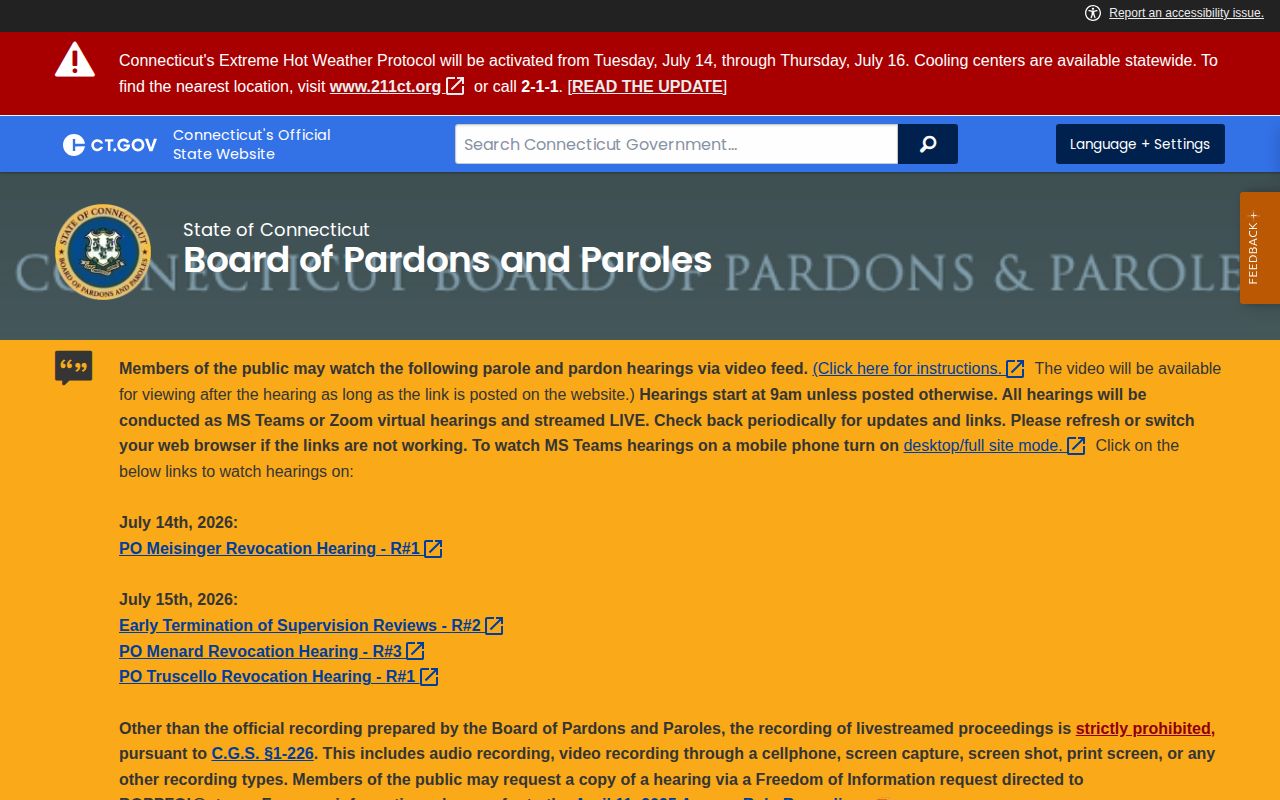
The image is a guide to the current board page, while the live page remains the source for dates and links that change.
Confirm a New Britain Release
Start with the latest agency in the chain. If the person is still listed in a DOC facility, the person has not yet left that custody. If the DOC result shows a community status, identify whether it is parole, special parole, transitional supervision, or another status. If the result is missing or stale, check Connecticut VINE for a recent custody change and contact DOC Public Information for formal clarification. VINE is support for notification, not the board decision record.
Then read the New Britain court case. The docket can explain the sentence, probation, a new charge, or another court event. Parole and probation may both involve community supervision, but the board does not impose ordinary probation. The court does. An erased, sealed, juvenile, or otherwise restricted record may not remain publicly visible.
The practical chain is: board eligibility and hearing → decision → DOC release processing → actual facility departure → field supervision → final discharge. Each arrow can have a different date. A good release check names the stage instead of calling every event “release.”
Note: The BOPP page is not a New Britain recent-release roster and should never be described as one.
Pardons Versus Parole Release
The agency name includes both pardons and paroles, but the processes are not interchangeable. Parole concerns conditional release and supervision within a sentence. A pardon concerns relief through the state pardon process. A person seeking release confirmation should use the parole side only when the custody or sentence record supports that route.
Connecticut erasure law can also affect later public visibility of police, prosecutor, and court records after specified outcomes and completion conditions. That is separate from a routine parole grant. Do not infer a pardon, erasure, or final discharge merely because an old case no longer appears on a public search. Confirm the legal event with the office that owns the record.
A well-framed board request states whether the question concerns eligibility, a hearing, a decision, an official recording, conditions, rescission, or revocation. These are separate records and stages. Include the CT DOC number when known and a narrow date span. If the concern is only whether the person has physically left a facility, start with DOC status instead of asking the board to recreate the entire custody history.
For New Britain cases, the board is one part of a state-run system. New Britain is a city, and there is no New Britain County parole board or sheriff jail. Using the exact state agency keeps a local arrest, DOC sentence, and board action from being blended into a false county record.
New Britain Board Verification
Record the hearing date, board outcome, DOC status, and court event separately. This short timeline shows whether the public evidence describes consideration, approval, actual release, supervision, or final discharge.