
ICE Release Records Are Separate
Connecticut DOC states that its inmate-information database excludes people held on behalf of federal immigration authorities. That exclusion is decisive for a New Britain search. A person may disappear from a state facility result because ICE received the person, not because the person entered the community. Likewise, a New Britain police or court release event does not answer whether an immigration detainer led to a second custody event.
Use ICE’s detainee locator for immigration detention and DHS VINE for supported federal immigration custody notifications. Do not use the Federal Bureau of Prisons locator unless the person was in BOP custody. Do not use Connecticut VINE as a substitute for DHS VINE. Each tool belongs to a different authority and may use different data feeds.
Search an ICE Detainee
The research confirms that ICE’s own locator is the correct search for immigration detainees, but it does not capture exact live interface labels or an official locator URL suitable for reproduction. Use the current official ICE locator reached through ICE resources, and avoid third-party forms. DHS VINE is the captured notification route.
- Confirm that the last known authority was ICE, DHS, or an immigration hold. A local arrest alone is not enough.
- Use the official ICE detainee locator and enter the immigration identifier requested by the current form when it is known. If the form permits a biographical search, provide the exact available details.
- Compare all returned identifiers. Names may have more than one form, and a common-name match is not reliable by itself.
- Read the facility or custody information as displayed. If the person remains detained, contact the responsible immigration authority or facility through official channels.
- If no result appears, verify spelling, identifiers, and whether the person is in Connecticut DOC, BOP, USMS, or local court custody instead.
- Use DHS VINE for notification options and confirm a claimed release or transfer with the responsible immigration source.
The New Britain released-inmate records path helps identify which system to search when the last custody authority is unclear. That is especially useful after a same-day move between local, state, and federal systems.
Note: A blank ICE search does not prove community release, and it does not prove that no immigration matter exists.
Read ICE Custody Changes
Immigration custody records can describe detention, movement, or departure from a particular facility. A public result may not explain the full legal event. Do not convert a location change into a claim that an immigration case ended. The responsible federal agency and immigration case records control the formal status.
| Result or event | Safe reading | Required follow-up |
|---|---|---|
| Facility shown | The person is associated with the displayed immigration custody location | Confirm current status with official ICE channels |
| Transfer | Custody location or authority changed | Follow the receiving facility or agency |
| Released or not detained | The displayed ICE detention status ended or changed | Confirm any supervision or case status separately |
| No locator result | No match under the search inputs and public scope | Check identifiers and other custody systems |
| DHS VINE notification | A supported custody event was reported | Verify the exact event with the originating authority |
A state DOC record and an ICE result can both be accurate for different times. Build a short timeline from the New Britain arrest, court action, DOC admission or release, immigration transfer, and later ICE status. Dates and authority names are more useful than a single isolated word.
DHS VINE Release Notifications
DHS VINE is the separate federal immigration notification channel identified in the research. It is not the Connecticut VINE state page and is not a historical list of all New Britain-related immigration releases. Use it to monitor supported custody changes, then return to the responsible federal authority for an official explanation.
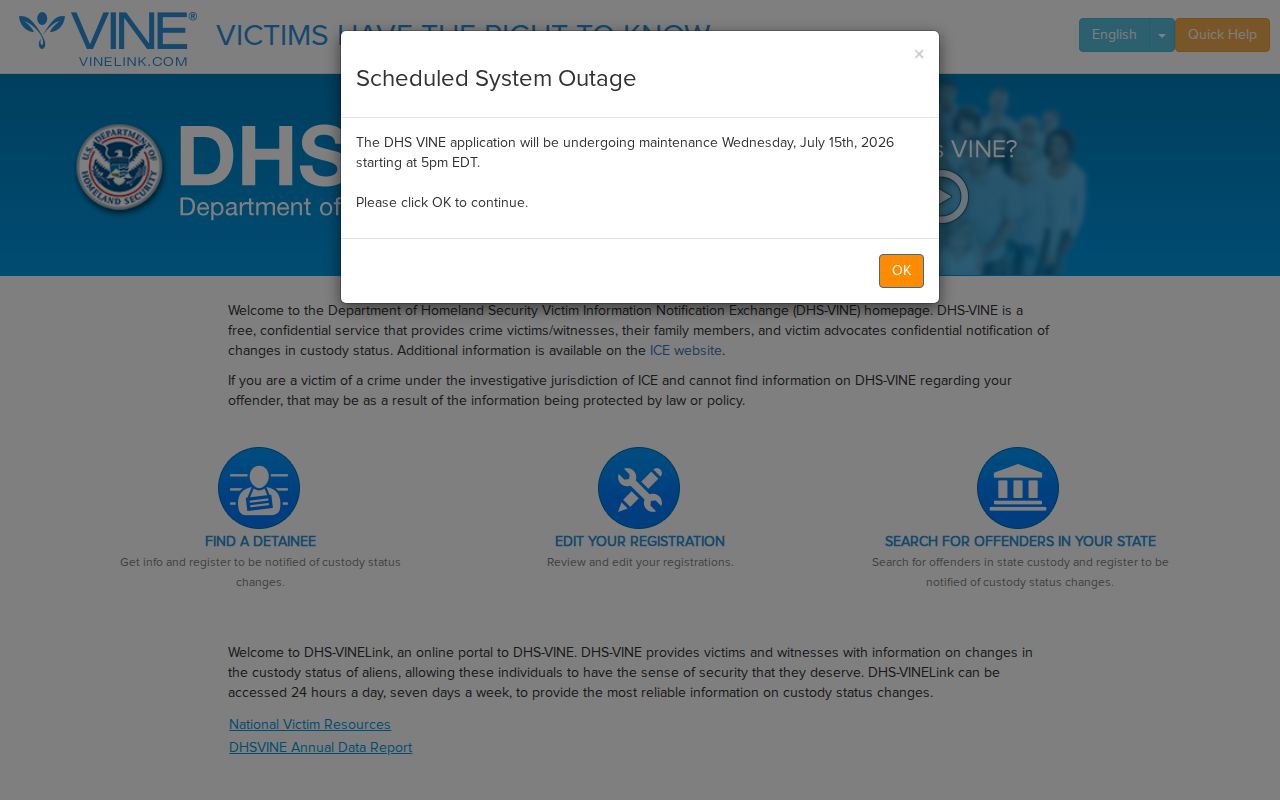
The screenshot identifies the DHS system so it is not confused with Connecticut’s state VINE service or a commercial locator.
When registration is offered, follow the live prompts and use only a contact channel the system supports. Save the confirmation details. Notification timing depends on the source feed, so an alert should be treated as a prompt to verify, not as a complete immigration record.
New Britain to ICE Transfer
A New Britain arrest can take several routes. Police may issue a summons, release on bond or a promise to appear, bring the person to court, or transfer the person into the Connecticut DOC process after arraignment. Hartford Correctional Center is the key state male pretrial facility serving New Britain court; York serves women statewide. None of those facts alone proves an ICE hold.
If immigration authorities take custody, the release chain changes: New Britain police or court custody → Connecticut DOC where applicable → release from the state authority → ICE reception → immigration detention, transfer, or later release. The state event may be called a release even though the person never entered the community. A receiving-agency record is needed.
| Authority | Correct tool | Not covered |
|---|---|---|
| New Britain Police | Police records and court docket | ICE detention status |
| Connecticut DOC | CT DOC inmate information and Connecticut VINE | People held for federal immigration authorities |
| ICE/DHS | ICE detainee locator and DHS VINE | Ordinary state prison status |
| Federal BOP | BOP inmate locator | ICE detention unless a separate BOP history exists |
| Connecticut court | Judicial Branch case record | Complete federal immigration case status |
The New Britain weekly police blotter is only arrest context. It is not a custody roster, ICE transfer list, or proof of release. Court and agency records should be used for the later steps.
ICE Locator Identity Checks
Identity matching deserves extra care. Names can be entered differently across police, court, DOC, and immigration records. A person may have more than one surname format, and the order of names may differ. Use the exact immigration number requested by the official tool when available. If searching by biographical information, compare every displayed detail.
- Immigration custody
- Detention or control by federal immigration authorities, separate from Connecticut criminal custody.
- Detainer
- A notice or request that can lead another authority to hold or transfer a person under applicable process.
- Transfer
- Movement from one facility or authority to another, not release to the street.
- Custody notification
- An alert from a participating data feed that should be confirmed with the originating agency.
- Community release
- Departure from detention into the community, which may still involve separate immigration conditions or proceedings.
Do not infer immigration status from a name, language, birthplace, or New Britain address. The relevant record must establish the custody authority. A wrong-person match can turn an ordinary local court case into a false claim about federal immigration detention.
Note: Use only the minimum personal facts needed to identify the correct official record.
ICE Release Record Requests
The detainee locator and DHS VINE are status and notification tools. They are not complete case files. A formal record request should identify the federal record owner and ask for a specific record or confirmation. The project research does not provide a verified ICE office address, regional phone number, or locator URL for publication, so none is invented.
Federal immigration custody notification
Separate from Connecticut VINE
Separate from CT DOC and BOP
Verify alerts with the originating agency
Connecticut DOC Public Information can clarify the state side of a transfer, but DOC cannot substitute for the federal immigration record. A New Britain police report or court docket may show the earlier local event, yet those records may not show where ICE moved a person later. Ask each authority only for the part it created.
A useful timeline request names the person, known agency identifiers, the New Britain case or incident number if relevant, and a narrow date range. It should ask whether the event was a release, transfer, or other custody change. That wording prevents a departure from one facility from being mistaken for the end of all custody.
After an ICE Release
A public locator can show that detention changed, but it may not explain every term that follows. The criminal and immigration systems remain separate. A Connecticut probation term can continue even if immigration detention ends. A federal or state court event can also remain active. Use the correct court and agency records to understand those parallel obligations.
When the result is urgent or conflicting, compare the time of the latest ICE/DHS update with the last CT DOC, court, or BOP event. Systems do not update at the same moment. A recent DHS VINE alert may precede a settled historical record, while an older state record may still show the prior facility.
The sound conclusion is narrow: identify the authority, state what its current record shows, and note the next official source. For New Britain, that method respects Connecticut’s state-run correctional model and avoids inventing a county jail or county immigration release list that does not exist.